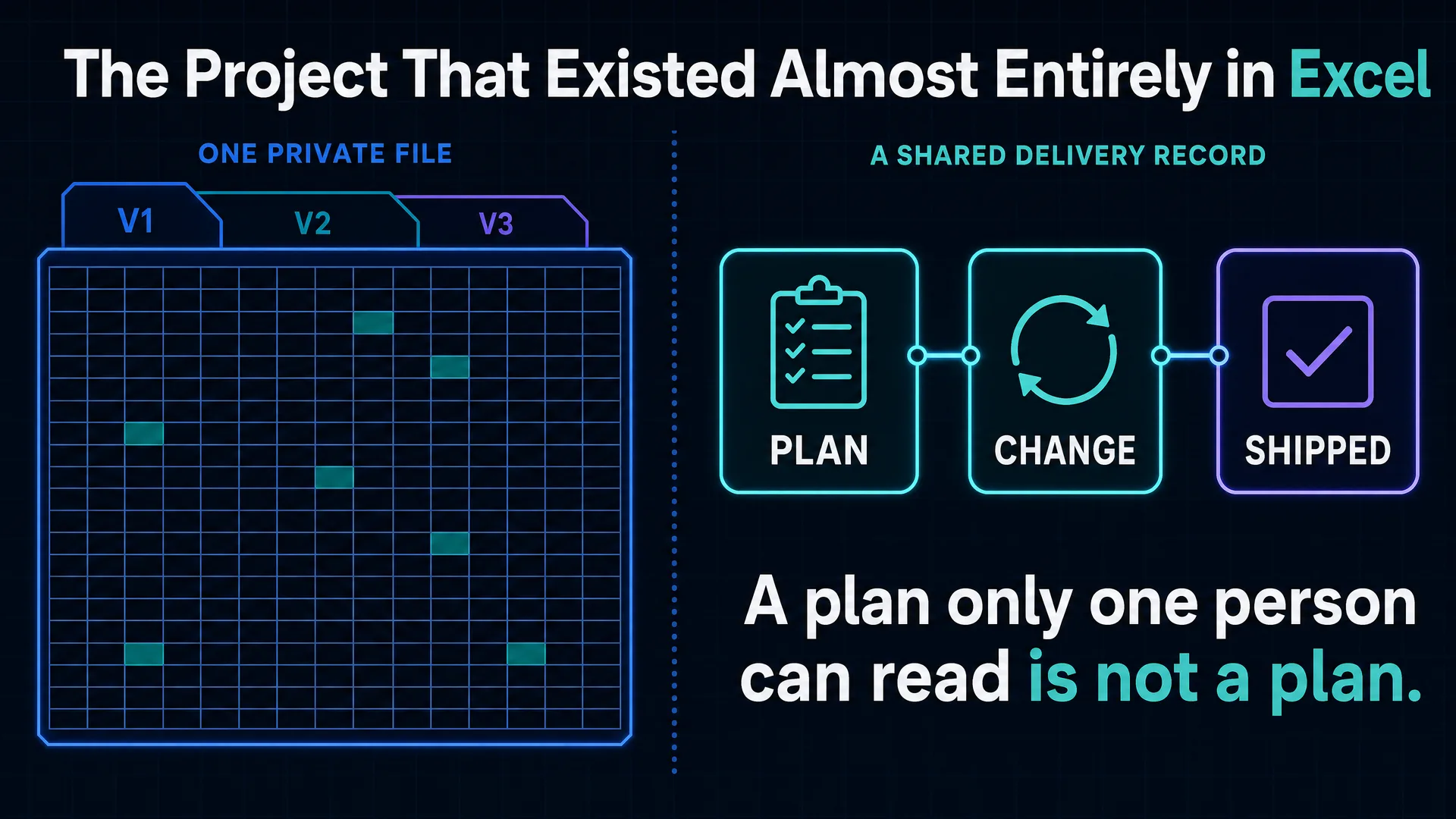
The most strategic project in the company arrived in my inbox as an email attachment.
The VP of Product had asked me to step in and help get the initiative moving. Step one, obviously: see the plan. I asked the project lead for it, and he sent it over within the hour — which, in hindsight, was the last time that project ever moved quickly on its own.
It was a spreadsheet. Hundreds of rows. A color system. Formulas feeding formulas. Its own vocabulary — real jargon, invented for this file, spoken fluently by exactly one person. It refreshed itself live. Somewhere along the way, the project lead had effectively built a roadmap application inside a spreadsheet.
It was genuinely impressive.
That was the problem.
The initiative deserved better
The project itself was exactly the kind of thing a company should do. One place where every user-behavior event on the platform — page views, feature usage, clicks, record changes — would land and become trustworthy. Joined with the customer and billing data that lived in the commercial systems. One home for the company’s KPIs, instead of a different answer from every vendor tool that happened to be collecting something.
Leadership believed it was underway, and that belief was reasonable. A detailed plan visibly existed. Its owner was visibly busy and reported that the initiative consumed half of his time. The topic appeared in reviews, with slides. Every signal an executive normally reads said: in progress.
Every signal, that is, except delivery evidence. Nobody had asked for that yet.
What the delivery evidence showed
When I went looking, this is what the organization’s actual systems had to say about its most strategic project.
The shared work tracker: nothing. No epic, no stories, no tickets. The initiative did not exist there.
The code history: nothing attributable to it. No ingestion work, no pipeline, no schema.
The infrastructure: no endpoint, no storage, no pipeline in any environment.
Months into the initiative, most of the planned work had not started — and nothing the organization could inspect said otherwise, because nothing the organization could inspect had ever heard of the project.
The only artifact that carried it was the spreadsheet. So I did the archaeologist thing and looked at the spreadsheet’s own change history, hoping to at least reconstruct how the plan had evolved. Dead end. The story kept restarting in a fresh file. Whatever the history of those months had been, it was not recoverable from the one place it could have lived.
A plan is not a record
Here is the distinction that whole episode taught me, and it is the one I want you to take away.
A plan tells you what someone intends to do. A record tells you what is actually happening, in a way a second person can inspect. The spreadsheet was a plan — a spectacular one. It was never a record, and the difference is not academic.
Because the plan lived outside every shared system, the project lead’s effort claim could not be checked. And I want to be precise here: it could not be checked in either direction. Half of his time may genuinely have gone into that file — thinking work, mapping work, the invisible labor of understanding a hard domain. Or very little may have. The organization could not tell the difference, and neither could he prove it.
A private plan cannot prove slacking, and it cannot prove diligence. It can only demand trust.
Meanwhile, every progress review had quietly turned into a guided tour. He presented the artifact; we admired the artifact; nobody could independently read the artifact, so nobody could ask a question the artifact’s author had not already decided to answer. The private vocabulary was not a quirk. It was load-bearing.
The pattern was consistent with a system built to need its author — the kind of setup that makes a person irreplaceable. Whether that was intent or just the way the file grew, I honestly cannot prove, and it barely matters. The operating effect was identical: nothing moved without him, and nothing about his work could be verified, including anything that might have vindicated him.
Who paid for it
The organization paid first. A quarter-scale slice of a strategic initiative’s calendar and budget went by without a reconstructable account of what it produced.
The engineers paid too, in a quieter way. There was real, pickable work inside that plan — months of it — and none of it could reach them, because it was encoded in a format and a vocabulary that required its author as an interpreter.
The project lead paid, eventually, in credibility. The system he had built could not defend him at exactly the moment he needed defending.
And I will include myself in the bill: I had been sitting near that project for months. I never once asked to see where its delivery record lived, because a plan existed and plans feel like progress. The right question — “show me where a second person can read this” — was available the whole time. Nobody asked it, including me.
What actually fixed it
My first action on the project was not technical, and it was not clever.
I converted the spreadsheet into one epic and roughly two dozen user stories in the shared work tracker, written in language an engineer could pick up without a translation session. That was most of the job: deleting jargon. Turning private vocabulary into ordinary tickets. It felt almost insultingly simple, which is worth sitting with — the blocker on a strategic initiative was a file format and a vocabulary.
Once the work was legible, it moved. Within a couple of weeks the pipeline was ingesting events, mostly by leaning on conventions the codebase already had: the back end’s existing event classes told us what each event meant, and a small front-end hook filled in the UI event payloads automatically and posted them to a dedicated ingestion endpoint. None of that was heroic engineering. It was ordinary work that had been waiting for a readable plan.
And here is the detail that still gets me. From the moment the work entered the shared system, everything about it was reconstructable — what was done, by whom, in what order, at what effort, straight from the tracker and the code history. The months before that moment remain a mystery to this day.
The accountable period and the unaccountable one are divided by exactly one line: where the record lived.
Nobody talks about those earlier months anymore. The organization took the loss and moved on. The part that still irritates me is that the loss was never even measured — because measuring it would have required the records that never existed.
How to see it coming
The shadow plan does not announce itself. It looks like diligence. The warning signs are quiet:
- The plan travels as an attachment, and “the latest version” is a fresh file.
- Progress reviews are guided tours of an artifact, not inspections of a record.
- The plan has private vocabulary, and questions route through its author.
- Effort claims are accepted because there is nothing to check them against.
- The shared tracker and the code history have never heard of the initiative.
Any one of these can be innocent. Two or more, on a strategic initiative, means the elapsed time is already unaccountable — you just have not needed the account yet.
The shadow-plan audit
Five questions. Ask them about any strategic initiative, especially the ones that look best in reviews.
1. Legibility
Could a second person pick up a work item from the plan today, without a translation session with its author?
2. History
Can you see how the plan changed — what moved, when, and why?
3. Effort
If the owner says the initiative consumes half their time, can any record confirm or challenge that?
4. Attachment
Does the plan live where delivery evidence — tickets, changes, deployments — can link to it?
5. Continuity
If the owner were unavailable next month, what would survive?
Fail two or more, and the correct status for the initiative is “unstarted,” whatever the spreadsheet says. The fix is not banning spreadsheets — a spreadsheet is a fine thinking tool. The fix is refusing to let a thinking tool impersonate a delivery record.
The Scopeworth lesson
The expensive part of that story was not the spreadsheet. It was that for months, “how is the strategic initiative going?” had no answer that did not route through one person’s mouth — and when the organization finally needed the real answer, the evidence to reconstruct it had never existed. Not effort, not cost, not decisions. The loss was absorbed unmeasured, which is the most expensive way to absorb a loss, because unmeasured losses repeat.
Scopeworth is being built to turn fragmented delivery signals into client-ready evidence — a record that exists while the work happens, not a story assembled afterwards from whoever speaks the vocabulary. It is early, and honest about that. But the principle behind it is the same one this story bruised into me:
A plan only one person can read is not a plan. It is a dependency.
Could you hand the plan for your most strategic initiative to a second person today, and have them pick up a work item without a translation session? If the honest answer is no, run the five questions above before you fund another month of it.